In this article
When a record appears inconsistent with your own understanding, the most useful opening is a fact that another person can check. That does not mean dismissing the concern or assuming that the record is correct. It means separating the observation from the explanation you have not yet received. This original conversation method is designed for ordinary factual questions, not for deciding a legal claim or prescribing Dollar Tree’s internal escalation process.
A discrepancy might involve a date, a recorded ending, an unfamiliar category, or two versions that do not match. Begin with one issue. If several matters are involved, list them separately so that an answer to one does not create the impression that everything is resolved. You can remain calm and specific while taking the concern seriously.
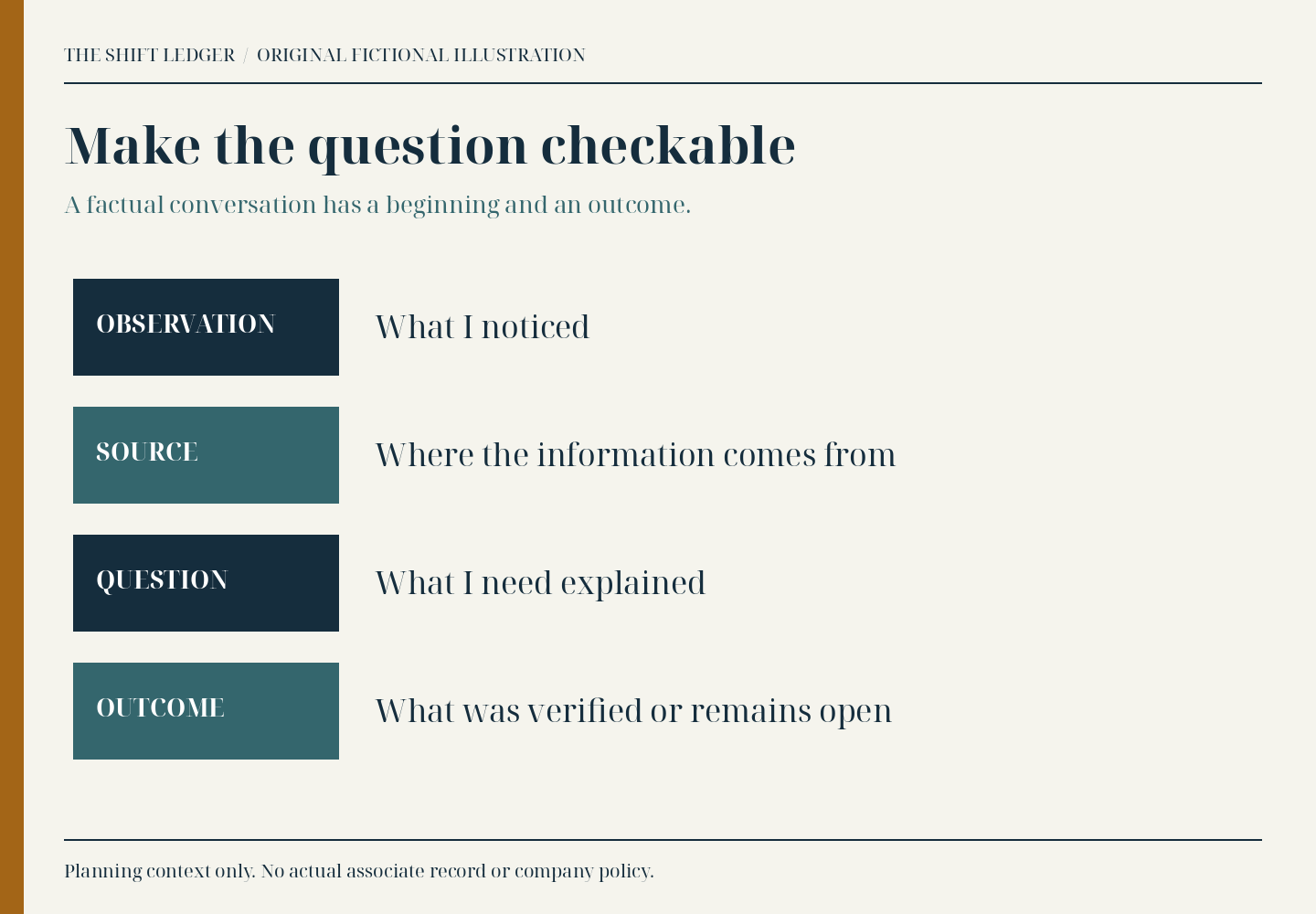
State the observation without the theory
Compare two fictional openings. “Someone removed my time” asserts a cause. “The record I checked shows an end time of 8:00, while my note from that evening says I finished a task around 8:20” identifies a difference. The second opening leaves room for a record error, a misunderstanding, a different field, or information you have not yet seen. It does not surrender the question.
Avoid filling uncertainty with accusations or self-blame. You do not know that another person acted deliberately, and you do not know that you must have remembered incorrectly. State the source and its limits. If your time is approximate, say so. If you have not yet viewed the relevant authorized record, your first request may simply be to identify or access the correct information through the established process.
Match the date and period first
Before discussing the amount or time difference, confirm that everyone is looking at the same work date and covered period. A payment date can distract from the actual date at issue. A revised record can also make a prior version appear inconsistent. Naming the dates early prevents a long conversation about two different documents.
A concise opening might be: “I am asking about the shift on October 20 and the statement covering October 12–25. Could we check which record applies?” Those dates are fictional. Use the exact labels from your own situation. If you do not know the covered period, ask for that clarification rather than choosing a date range that makes your comparison seem complete.
Ask for the explanation you actually need
A request to “fix it” may be appropriate once an error is established, but an initial question often needs a definition or comparison first. Ask which entry reflects the event, what a code means, or how the difference arose. The answer may establish a correction, explain the display, or show that another record is needed. Each is a useful result if it is specific.
Keep the request answerable. “Could you check the end time for that date and tell me what the record shows?” is narrower than “Why is payroll always wrong?” A broad pattern can be raised later with supporting examples. Starting with one traceable issue reduces the chance that a general discussion ends without anyone checking the actual record you are concerned about.
Bring only the relevant material
Prepare a short private summary and keep the supporting information available through authorized access. Do not lead with an enormous folder of screenshots, especially if it includes coworkers, customer details, or unrelated personal information. Identify the specific record that supports each observation. If a document must be shared, use the employer’s verified channel and follow its instructions.
A useful summary has four parts: the date, the observation, the source, and the question. It can also state what you have already checked, such as matching the covered period. Avoid including speculative motives or unrelated disagreements. The more clearly the material points to the issue, the easier it is for the recipient to respond without asking you to reconstruct the entire week.
Separate acknowledgment from resolution
“I will look into it” is an acknowledgment and a next step. It is not yet an explanation or correction. Record the status honestly and ask how you should expect to learn the result. If a response time is not given, ask when it would be reasonable to check back. Do not invent a deadline on the other person’s behalf or treat silence as evidence that the issue was accepted.
If the answer is verbal, summarize what you understand: “So the next step is to compare that date’s entry, and I should check back through this channel.” Use the workplace’s ordinary process for any written follow-up. A concise confirmation can prevent a pending review from becoming confused with a completed change, while avoiding repeated messages that contain no new information.
Check the outcome against the original question
When a response arrives, return to your original observation. Does the explanation identify the date, field, and relationship you asked about? If a correction is said to be made, ask how and where you can verify it through the authorized record. A reassuring phrase alone may not resolve the practical uncertainty. Conversely, a clear explanation may show why no change is needed.
Do not move the goalposts simply because the answer differs from your first theory. Review the evidence and acknowledge what it supports. If something remains unexplained, state that remaining point rather than repeating the entire complaint. For example, “I understand the period now; I still cannot reconcile the end time on October 20.” That keeps the next conversation focused and fair.
Know when this method is not enough
A routine clarification method is not a requirement to tolerate unresolved pay concerns, retaliation, threats, or other serious problems. You can seek appropriate official or qualified help without completing every step in this article. Applicable rights and procedures depend on the facts and location. This publication cannot decide whether an individual action is lawful or identify every available remedy.
The U.S. Department of Labor’s Wage and Hour Division provides public information and contact routes for wage-and-hour questions. State agencies or qualified advisers may also be relevant. Verify the official source and keep private information within the appropriate channel. An independent magazine is not an employer representative, government intake service, or secure place to submit an employment file.
Leave a clear closing note
When the issue is explained or corrected, record the outcome briefly and retain only what you need through appropriate means. If it remains open, record the unresolved question and next step. Do not mark it resolved just because a conversation ended, and do not keep it perpetually open after the evidence answers it. An accurate status matters as much as an accurate opening.
Calm factual language is a tool for clarity, not a demand that you feel a particular way. You can be frustrated and still organize the question well. The strongest conversation gives the recipient something concrete to check and gives you a way to recognize a meaningful answer. That is the practical value of separating observation, explanation, and resolution.
Sources and scope
Public context checked October 15, 2026. The planning methods and fictional examples are original editorial work. Sources support only their stated public or federal context; they do not verify an individual schedule, pay record or company policy.
- U.S. Department of Labor Wage and Hour Division — Official federal information starting point. Readers may seek help without completing the magazine method.