In this article
The schedule, the hours worked, and the pay period answer different questions. Confusion begins when a date or total from one is used as though it belongs to another. A future shift is a plan. A time record concerns work that occurred. A pay statement covers an identified period and payment event. This guide builds an original three-part reading method without asserting Dollar Tree’s payroll calendar, pay frequency, cutoff rules, or individual record format.
Start by putting a label beside every number you compare. “Six hours” could mean the span between scheduled start and finish, a recorded quantity, or a figure in an earnings row. “Friday” could mean the day worked, the period ending, or the payment date. Those labels are not decoration. They determine whether the comparison you are about to make is meaningful.
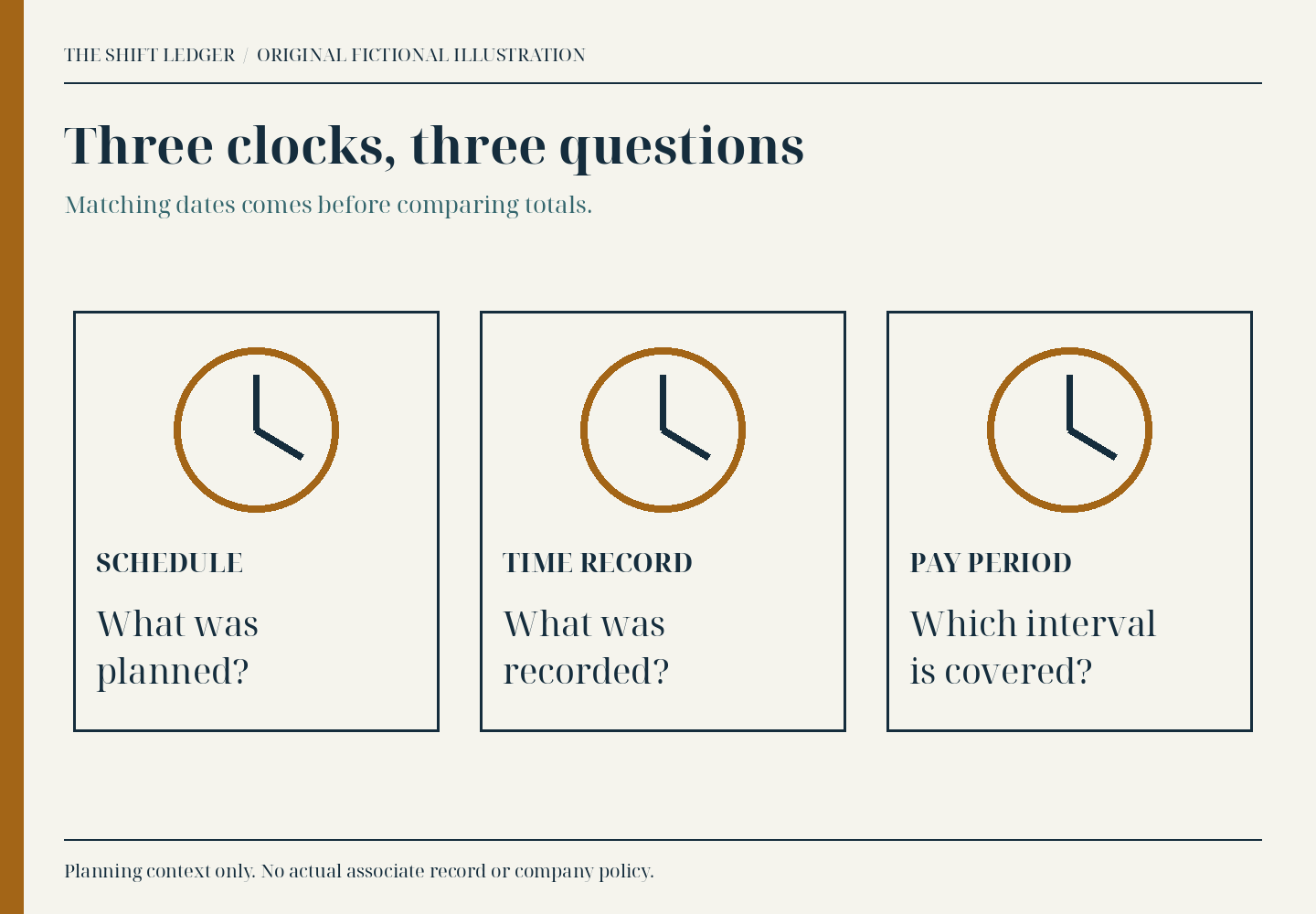
The schedule asks what is expected
A schedule is useful for planning travel and outside commitments. It is not proof that every planned minute became worked time or that the schedule never changed. Keep a dated version for your own planning within workplace rules, and identify requested changes separately. If the schedule is revised, update the practical plan without rewriting your memory of what actually happened on earlier days.
In a fictional week, you might have three six-hour scheduled spans and one five-hour span, totaling 23 hours of calendar blocks. That total is suitable for an initial away-from-home sketch before adding travel. It is not automatically a payroll quantity. On-site intervals, changes, and actual events may require different treatment in the official record. Do not make the planning total carry more meaning than it has.
The time record asks what was recorded
An authorized time record can show the employer’s recorded information about actual work. Read its labels and dates rather than assuming that every displayed total has the same definition. If you do not understand a category, ask what it includes. A short label may refer to a calculation or status that is not obvious from the screen alone.
Your personal recollection can prompt a question, but it does not automatically override the record. The reverse is also important: a displayed number does not explain an apparent discrepancy simply because it appears in a system. Compare the relevant details calmly. Keep the event date, the record version, and the uncertainty distinct so that a correction or explanation can be traced back to the right place.
The pay period asks which interval is covered
Find the period beginning and ending dates on the pay statement or the employer’s explanation of it. Then locate the dates you are trying to review. Do not assume that the week immediately before payday is the exact covered interval. Do not infer the cutoff from a bank notification. The payment date and the dates of the underlying work serve different purposes.
For a fictional illustration, a statement paid on October 30 might identify a covered period of October 12 through October 25. Those dates are invented and are not a Dollar Tree calendar. Work on October 27 would fall outside that illustrated interval even though it occurred before the payment date. The example teaches date matching only; it does not explain when any real employer pays a particular shift.
Build a date map before adding hours
Write three short lines: the schedule dates being discussed, the actual work dates at issue, and the pay-period dates shown on the statement. Mark where the relevant date falls. This simple map often reveals that two people are looking at different intervals. Resolve that mismatch before calculating a difference or describing a missing amount.
If a shift crosses midnight, use the employer’s documented record convention and ask how it is represented rather than assigning it to a day yourself. Your household calendar can show the full overnight block, while a payroll system may organize the information differently. The magazine does not decide that convention. Preserve the actual start and finish dates in your question so the person answering knows which event you mean.
Keep payment arrival out of the first comparison
A bank or payment-service notification concerns a destination and a transaction. It is not the same document as the employer’s pay statement. If a question concerns an earnings category, begin with the statement and relevant time record. If it concerns arrival at a payment destination, the appropriate sources may be different. A single observed balance cannot explain both kinds of question.
Avoid reconstructing earnings from the amount that arrived. Multiple deductions, adjustments, or payment instructions can make that reverse calculation misleading. Even a correct subtraction does not identify the categories that produced it. First ask what record and period you are looking at. This keeps a missing-record question from becoming a speculative deposit-timing theory or an unsupported claim about the employer’s process.
Treat a revised record as a new version
When a correction appears, determine which earlier record or period it refers to. A correction may be visible on a later statement without changing the date on which the original event occurred. Keep those dates linked rather than adding every visible number together. Ask how the correction is labeled and which record should be used for the comparison you are making.
A fictional note might say, “October 20 event; question raised November 2; explanation refers to a later adjustment.” That is a timeline, not a conclusion that the adjustment is correct. You still need the record-specific explanation. The timeline helps everyone locate the same issue and avoids treating the date of the conversation as though it were the work date.
Know the narrow federal context
The Department of Labor’s Fact Sheet 21 lists daily hours, workweek hours, payment dates, and covered pay periods among records required of covered employers for nonexempt workers. Those separate categories support the basic distinction in this article. They do not establish a universal pay-stub design, Dollar Tree’s individual practices, or the outcome of a wage question in a particular location.
State requirements, the facts of the work, and other applicable rules can matter. This publication is an educational planning resource, not a legal determination. You do not need to solve every date question on your own before contacting an appropriate employer representative, government agency, or qualified adviser. The method is intended to make the question easier to explain, not to create a barrier to help.
Finish with a record-specific question
Replace “my hours look wrong” with the narrowest accurate question you can formulate. For example: “I am checking the work on October 20 against the statement covering October 12–25. Which time record and earnings line should I compare?” The dates and periods in that sentence are fictional. Use the labels actually present in your own authorized records rather than copying the example mechanically.
A good comparison ends with one of three outcomes: the records are now understood, a specific discrepancy remains, or a needed record or definition is still missing. Each outcome supports a different next step. Keeping the three clocks separate helps you choose that step without making the schedule, the time record, or the pay date answer a question it was never designed to answer.
Sources and scope
Public context checked October 15, 2026. The planning methods and fictional examples are original editorial work. Sources support only their stated public or federal context; they do not verify an individual schedule, pay record or company policy.
- DOL Fact Sheet 21: Recordkeeping — Narrow covered-employer/nonexempt recordkeeping context; distinct daily/workweek hours, payment dates and pay periods. No universal pay-stub format.