In this article
A commute buffer is a planning margin for uncertainty. It is not a magic number and it is not a payroll category. The right question is not simply “How long is the trip?” It is “What sequence must work for me to arrive when I need to, and which part is most likely to fail?” This original exercise uses fictional journeys to make those dependencies visible without claiming a Dollar Tree attendance rule or deciding whether any particular travel time is compensable.
Begin with the whole trip: leaving home, reaching the vehicle or stop, waiting, traveling, walking from the arrival point, and finding the appropriate entrance. A navigation estimate may cover only part of that sequence. If you copy its number directly into your workweek calendar, you may erase the waiting and walking that make the difference between a comfortable arrival and a rushed one.
Build the route from small pieces
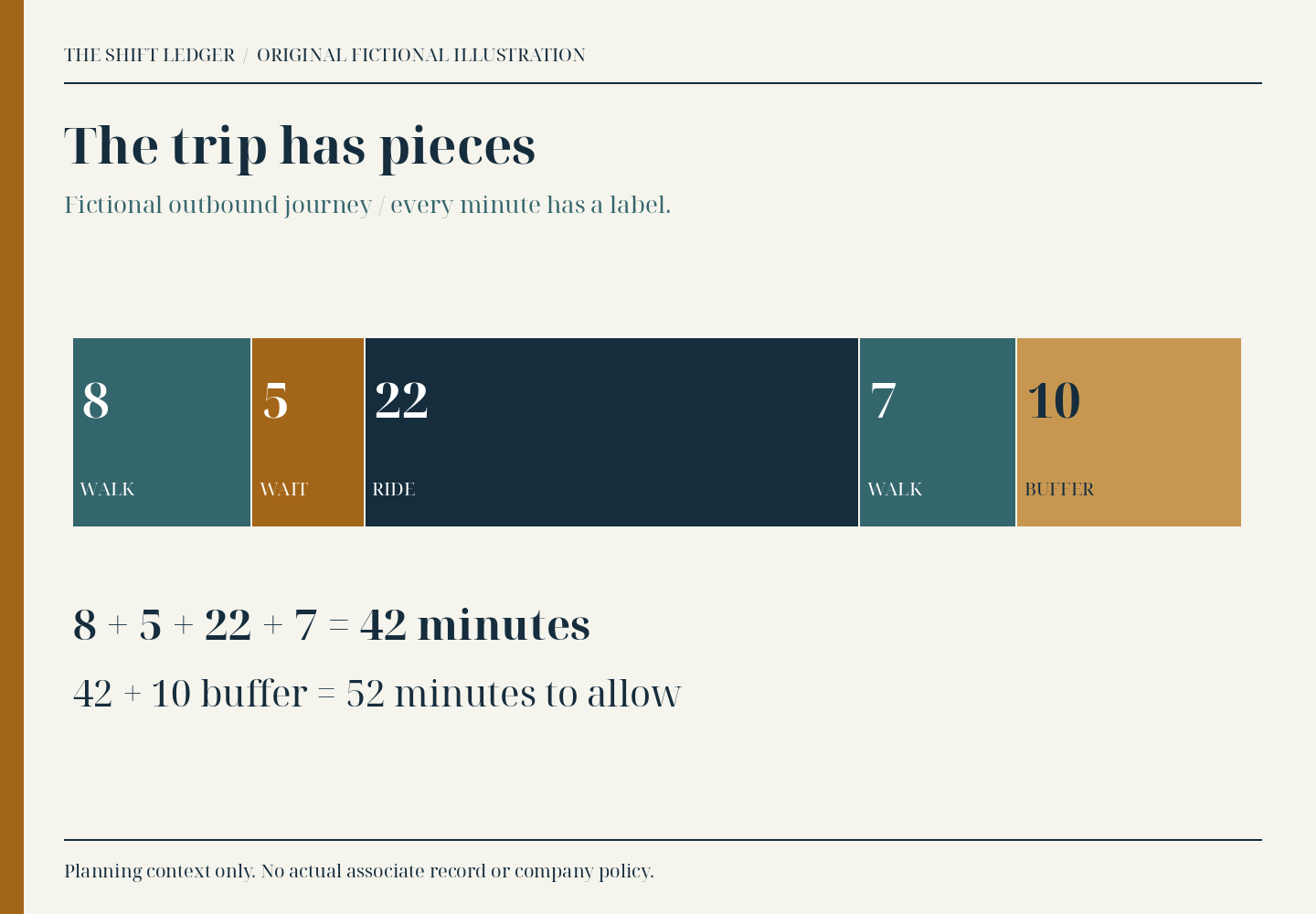
Suppose a fictional bus trip includes eight minutes walking to the stop, five minutes of expected waiting, 22 minutes riding, and seven minutes walking after arrival. The planned journey is 42 minutes. If you choose a ten-minute uncertainty margin, your calendar needs 52 minutes before the time you intend to arrive. Each piece is visible, so you can update the one that changes.
Do not add a margin twice. A transit planner may already suggest arriving early at a connection, while your own note adds another wait. That can be intentional, but label it. Equally, do not assume an estimate contains a buffer when it does not say so. A clear sequence is more useful than a single inflated total whose ingredients you cannot explain or adjust.
Distinguish ordinary variation from a missed connection
Some delays add a few minutes. Others make you wait for the next departure and add much more. A fictional bus running every 30 minutes creates a different risk from a car journey with a five-minute variation. If missing one connection changes the arrival by half an hour, show that as a separate scenario. Do not average the problem into a misleadingly small cushion.
Write two versions: the usual workable route and the route after the critical connection is missed. Then identify what you would do if the second version occurred. That might mean contacting the workplace through its established channel or using a previously checked alternative. Do not assume a ride service, friend, or coworker will be available without confirmation. An unverified backup is a possibility, not a plan.
Work backward from a realistic arrival
Choose the arrival time needed for your actual situation using current workplace instructions. Then subtract the travel sequence and your voluntary margin. This article does not tell you to perform work before a recorded start or treat early arrival as unpaid labor. It concerns the logistics of reaching the location. Questions about work performed, time recording, or compensability belong with appropriate employer and official guidance.
For an illustrative 2:00 p.m. arrival and a 52-minute travel allowance, the departure target is 1:08 p.m. You might choose a memorable earlier departure, such as 1:05, rather than pretend that minute-level precision controls the bus. Label the target as a planning choice. The arithmetic helps you see the structure; it does not make a transportation system operate exactly to your private timetable.
Check the return trip separately
Outbound and return travel are not necessarily symmetric. Service frequency, traffic, lighting, weather, and the availability of a ride can differ later in the day. Build a separate return sequence. If a shift finish changes, revisit the return route even when the start and outbound trip stay the same. This is where a small schedule edit can have a large practical effect.
In a fictional evening, the normal return takes 40 minutes, but the next viable bus after a later finish takes 70. That additional half hour belongs in the household plan. It may affect dinner, a shared vehicle, or the next morning’s preparation. Do not hide it inside “home after work.” An honest return window is kinder to everyone relying on the plan, including you.
Make the buffer serve a specific risk
A useful margin has a reason: a variable connection, a long walk through the site, or an unfamiliar route. Review that reason after you have actual observations. If the trip repeatedly takes longer because the estimate omitted a walk, correct the base estimate instead of calling the missing walk “buffer.” The buffer should address uncertainty, not conceal a known part of the journey.
Avoid turning every unusually bad trip into a permanent assumption. Record what made it unusual and whether it is likely to recur. A road closure with a known end is different from daily congestion. The goal is neither maximum possible caution nor optimistic compression. It is a plan that reflects the recurring conditions you can observe, with room for the uncertainty you cannot eliminate.
Keep a tiny travel log
For a short learning period, you could note your own departure, arrival, and the main delay, without tracking location continuously. Use a format appropriate to your privacy needs. You do not need to record another person’s address, license plate, or personal details. A note such as “Tuesday return: missed connection; 25 extra minutes” may be enough to improve the next plan.
Decide what you are trying to learn before collecting information. If the question is whether a particular departure works, a few relevant observations are more useful than a sprawling diary. Once the pattern is clear, update the estimate and stop collecting unnecessary detail. This is a practical planning exercise, not surveillance of your route or a requirement to prove your travel experience to this publication.
Keep logistics separate from pay questions
The Department of Labor’s Fact Sheet 22 distinguishes ordinary home-to-work travel from travel that forms part of the workday, and it discusses other fact-dependent categories of time. That narrow federal context does not settle an individual case, state requirement, or employer policy. Our commute block is simply a household time allocation. Its inclusion in a weekly sketch says nothing about whether it should appear as paid time.
If you have a work-related travel question, record the actual circumstances and ask an appropriate source. Do not decide the answer from a calendar color or a generic phrase like “commute.” The same word can hide different facts. Separating the practical time budget from the compensation question helps both: you can plan the day while preserving the details needed for a proper explanation.
Choose a departure plan you can act on
A finished commute plan should fit in a few lines: the intended departure, the critical connection, the expected return window, and the action if the route fails. Keep official route information current. If the route becomes unreliable enough to affect your availability, describe the recurring constraint in a separate workplace conversation rather than silently hoping it improves.
A buffer is successful when it prevents a predictable conflict or makes an uncertain one visible early. It should not become a moral judgment about punctuality or an excuse to dismiss transportation difficulties. Use the arithmetic to understand your week, then use confirmed information and clear communication to decide the next step. The strongest plan is the one whose assumptions you can see and revise.
Sources and scope
Public context checked October 15, 2026. The planning methods and fictional examples are original editorial work. Sources support only their stated public or federal context; they do not verify an individual schedule, pay record or company policy.
- DOL Fact Sheet 22: Hours Worked — Narrow federal context for fact-dependent travel and rest/meal categories; no individual determination.