In this article
A work schedule affects more than the person whose name appears beside the shift. It can change when a shared vehicle is available, who handles a meal, and whether an evening task can happen at all. A useful household plan translates the schedule into practical commitments without exposing private employment records. This is an original planning framework for everyday coordination, not a claim about Dollar Tree benefits, leave, or scheduling rights.
Begin with the time you expect to be unavailable and the time you realistically expect to return. Include travel and a visible uncertainty margin. A shift ending at 8:00 p.m. does not mean you can take over a household task at 8:00. The household needs the actual handoff window, not just the official-looking work block on your calendar.
Share the practical timing
Choose the smallest amount of information that helps the other person plan. “Away from about 1:15 to 8:45 on Tuesday” may be enough. You do not need to forward a staff roster or explain payroll details. If the timing is not confirmed, say so. A shared calendar entry should distinguish a settled arrangement from a possibility that still needs a workplace answer.
Ask what the other person needs to know rather than assuming your own calendar format works for them. One person may need a return window; another may need the shared vehicle’s availability. A large amount of detail can still omit the practical fact they rely on. Good coordination is about the relevant dependency, not complete access to one another’s information.
Give every handoff an owner
A task is not covered simply because it appears on a shared list. Identify who has agreed to handle it and when the handoff happens. If no one has agreed, mark it unresolved. This is especially important when a revised work time affects a commitment that another person had already organized around the earlier plan.
Use a direct question: “My return is now likely closer to 8:45. Can we decide who will handle the earlier task?” Avoid phrasing that assumes agreement, such as “You will need to do it now.” The other person may have constraints you cannot see. A workable plan needs their actual answer, and sometimes the answer will require reducing or postponing the task rather than reallocating it.
Separate essential tasks from preferred tasks
Not every household task needs to happen on the same day. Identify what has a genuine deadline, what affects someone else, and what can wait. A busy workday is easier when it has a smaller realistic list. This is not a productivity competition. The purpose is to prevent optional tasks from consuming the margin needed for essential commitments and ordinary recovery.
In a fictional evening, preparing tomorrow’s required items may matter more than reorganizing a cupboard. A simple meal may be more workable than an elaborate cooking plan. The right choice depends on your household, not a universal ranking from this publication. Ask which task would create the biggest practical problem if missed, then give that task a clear place in the plan.
Budget rest as time, not as leftover space
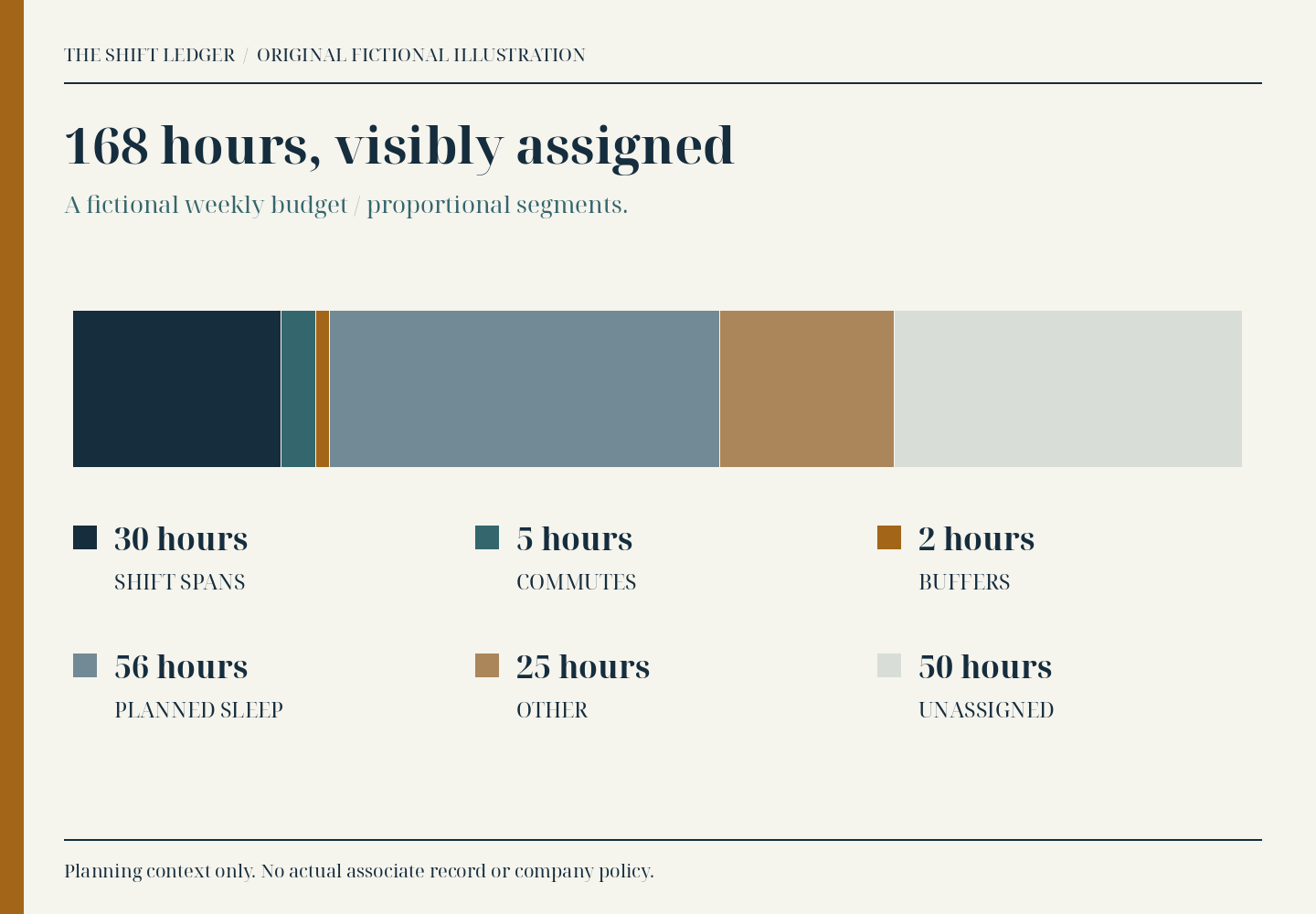
A weekly sketch can include a planned sleep allocation and other unstructured time. The numbers are personal planning inputs, not medical recommendations. Do not treat whatever remains after work and chores as automatically sufficient rest. A remainder may be fragmented into short intervals, and a large weekly total can conceal a very tight transition between two particular days.
Look at the actual sequence around an evening finish and the next fixed morning commitment. Travel, food, preparation, and ordinary winding down occupy time even when a calendar leaves the boxes blank. The sketch can help reveal that compression, but it cannot assess fatigue or health. If a health concern affects your ability to work or rest, seek appropriate professional guidance rather than relying on a generic budget.
Create one low-effort fallback
A fallback should reduce decisions when the day runs late. It might be a simpler meal, a task moved to another day, or a previously agreed handoff. Check that it is genuinely available. A fallback that depends on an unasked favor is another unresolved dependency. Keep it modest enough that it does not require extensive preparation to become usable.
For the fictional Tuesday, the ordinary plan might be dinner together after returning. The fallback could be separate meal timing if the return is delayed. That may be more practical than asking everyone to wait indefinitely. Agree on the trigger in ordinary language, such as “If I will be later than the return window, I will update you when I can.” Do not promise communication you cannot safely or appropriately send during work.
Revisit the household plan after a schedule change
When work changes, scan the dependent commitments in order: departure, transport, shared resources, return, and the next day. A revised finish may affect the next morning more than the evening itself. Update only the items that actually changed so that the household can see the new information without rereading an entire weekly plan.
Avoid sending a series of speculative updates every time an option is discussed. First distinguish what is confirmed from what is pending. Then communicate the material uncertainty early enough for others to plan. “I am checking whether Friday’s later finish is final; the evening handoff may need to change” is honest. It is better than either presenting a possibility as settled or hiding it until the last moment.
Keep the conversation about capacity
If the plan repeatedly fails, discuss the workload and timing rather than treating each missed task as a character flaw. A week may contain more commitments than its available time supports. The arithmetic can help name that problem, but it cannot decide what your household values or who should do what. Those choices require conversation and agreement.
Bring one concrete pattern: “The late return leaves no reliable window for this task on Tuesdays.” Then consider moving it, simplifying it, sharing it by agreement, or discussing the underlying work availability. Do not assume every recurring conflict can be solved by being more organized. Sometimes the useful conclusion is that the current combination of commitments needs to change.
Close with the next reliable handoff
A household plan is successful when people know what they can rely on and where uncertainty remains. Before the week begins, identify the next important handoff and confirm it. Keep later details flexible if they are not yet known. This prevents the calendar from becoming a false promise of control over every day.
The Shift Ledger’s Workweek Balance Sketch can illustrate the broad time budget with invented values, but the real coordination happens through confirmed information and respectful discussion. Use the sketch to notice pressure, then use a small set of agreed actions to respond. A less crowded plan with clear ownership is often more dependable than a perfectly filled calendar that leaves no room for ordinary life.
Sources and scope
Public context checked October 15, 2026. The planning methods and fictional examples are original editorial work. Sources support only their stated public or federal context; they do not verify an individual schedule, pay record or company policy.
- Dollar Tree public careers benefits summary — Public overview only. It states eligibility requirements and governing plan documents; no individual enrollment, leave, availability or payroll inference.