In this article
A workweek is easier to understand when its different promises stop competing for the same square on a calendar. There is the schedule you have been given, the time you actually spend working, the travel around it, and the life that still needs room afterward. For a Dollar Tree associate, a useful personal plan begins by keeping those things separate. A colorful calendar alone cannot confirm a shift, explain a pay record, or create more hours in a day.
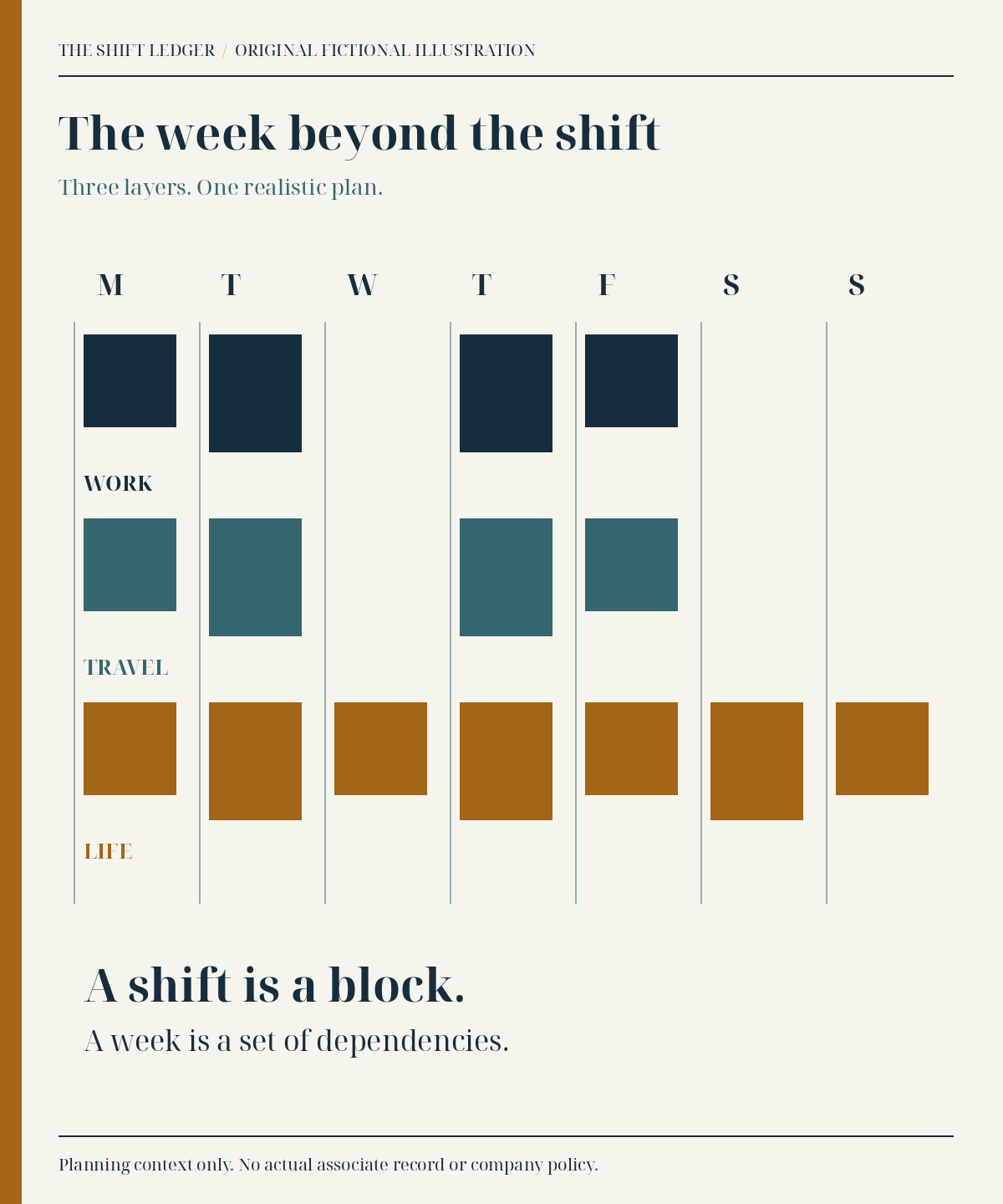
This guide offers an original planning method, not a statement of Dollar Tree scheduling policy. The fictional week below belongs to no real associate or store. Use it to practice noticing dependencies before making commitments. Confirm your actual schedule, reporting arrangements, and questions through the channels your workplace provides. The point of the exercise is a smaller, clearer set of questions and a more realistic picture of your available time.
Start with a dated version
Write the dates covered by the plan and when you last checked the schedule. A note that says “Tuesday, 2–8” is incomplete: which Tuesday, which time zone, and was that the latest version? Include the date beside every shift. Use a recognizable status such as confirmed, requested, or waiting for clarification. These are personal planning labels, not employer system statuses. A requested change should not silently become a confirmed shift in your own calendar.
Keep the original schedule reference available through your authorized workplace access. If your employer permits a personal record of your own times, capture only what you need. Do not photograph a whole staff roster, copy coworkers’ details, or move confidential business records to a personal account. A private note can say “checked my Tuesday start on Monday evening” without reproducing the entire workplace screen. The narrower record is often easier to find later.
Draw the whole away-from-home block
Imagine a fictional shift running from 2:00 p.m. to 8:00 p.m. The planned span is six hours. If the outbound trip takes 35 minutes, a voluntary arrival buffer is 10 minutes, and the return takes 40 minutes, the household calendar needs a block from 1:15 p.m. to 8:40 p.m. That is seven hours and 25 minutes away from home, before any additional stop. It is not a calculation of paid hours.
This distinction changes ordinary decisions. A delivery window ending at 1:30 p.m. may conflict even though work begins at 2:00. An 8:15 dinner promise may be unrealistic even though the shift ends at 8:00. Travel and buffer assumptions should be visible, so someone helping with a ride or household task can understand the commitment. Do not hide a fragile connection inside a single optimistic arrival time.
Budget categories without counting them twice
A week contains 168 hours. For a fictional illustration, set aside 30 hours of shift spans, five hours for commuting, two hours of travel buffers, 56 hours of planned sleep, and 25 hours for household and personal commitments. The arithmetic leaves 50 hours not assigned in this sketch. It does not mean 50 freely usable hours. Small gaps, uncertain shift endings, meals, recovery, and tasks you forgot to list can occupy that remainder.
Use nonoverlapping categories. If your 25 household hours already include meals, do not subtract meals again in another field. If a shift span includes an on-site meal interval, do not remove that interval from the away-from-home block simply because its payroll treatment may differ. Our Workweek Balance Sketch deliberately works with time blocks rather than wages. Its totals can expose an overfilled plan, but they cannot judge legal compensability or personal well-being.
Mark hard edges before flexible tasks
Some obligations have a hard start or finish: a class, a transit departure, a scheduled appointment. Others can move: folding laundry, choosing groceries, an optional social visit. Identify which is which before attempting to fit everything around work. A task that is usually flexible may become fixed when it depends on another person. Ask rather than assume that someone else can rearrange their day every time your own schedule changes.
Try placing one household anchor before and one after the work block. In the fictional Tuesday, a small grocery pickup could happen before 12:30, while preparing tomorrow’s clothes could happen after returning. Avoid building an elaborate routine into a ten-minute gap. A plan with one reliable action is more useful than a detailed timetable that fails at the first delayed bus. Leave some transitions visibly unassigned rather than pretending that every minute is predictable.
Keep availability separate from the schedule
Availability describes the times you tell your workplace you can work. The schedule describes the work you have actually been assigned or confirmed. A personal preference, a submitted request, and an approved arrangement are different facts. Record the effective date of an availability conversation and whether you received an answer. If the answer is unclear, ask what applies to the upcoming week rather than interpreting silence as agreement.
For example: “Beginning November 2, I can arrive after 3:00 p.m. on Wednesdays. What is the process for requesting that change, and when will I know whether it applies?” The wording states a constraint and asks for the process. It does not promise unlimited flexibility or claim that a change is already approved. More specific requests are easier to discuss than “my schedule is getting difficult,” although that broader concern may still be important to raise.
Give changes a place to land
When a shift moves, update more than the work block. Recheck the trip, the household handoff, any appointment, and the next day’s first commitment. A two-hour later finish can create a bigger problem than its calendar size suggests if the usual ride no longer runs. Write the unresolved dependency beside the revised shift. “Return trip unconfirmed” is more useful than an attractive calendar that conceals the missing ride.
Maintain a brief change note: the date affected, the earlier understanding, the revised information, and when you confirmed it. Do not build a dossier of accusations or speculate about motives. The note’s purpose is to avoid relying on an outdated version and to help ask a precise question if two sources disagree. If you cannot confirm what to do, use your established workplace contact promptly. A magazine example cannot decide attendance obligations for your situation.
Close each day with facts, not reconstruction
A personal planning calendar should not be treated as a time clock. Keep actual-time observations separate, following workplace rules and using only information about your own experience that you may lawfully retain. If something unexpected happened, note the date and the fact while it is fresh. “I recall finishing at about 8:20; need to verify” is more honest than replacing an uncertain memory with an exact-looking time.
The Department of Labor’s Fact Sheet 21 describes covered employers’ recordkeeping duties for nonexempt workers, including daily and workweek hours and payment-period information. That federal context does not make this personal notebook the employer’s record or establish the rules for every worker. Our suggested notes help organize a question. They do not transfer the employer’s responsibilities to you or require you to complete an elaborate system before seeking help.
Separate the three review moments
A before-week review asks whether the plan is workable. A short after-shift note records anything that needs checking. A pay-period review compares the relevant records and dates. Trying to do all three at once encourages mistakes. You may start interpreting a future schedule as completed work, or treat a payday as the date on which every shift occurred. Put the appropriate question beside each review rather than mixing them in one running total.
The fictional Wednesday example illustrates this. On Sunday, you plan a six-hour shift span. On Wednesday, you note that an ending time needs confirmation. When a pay statement arrives, you first identify the covered period and locate the relevant record. You have three observations with three dates, not one unquestionable number. That structure makes a calm conversation possible even when the final explanation is not yet known.
Make the plan small enough to maintain
Choose the lightest format that you can actually keep current: a private paper sheet, a simple device calendar, or a brief note. Follow any workplace restrictions and consider who can see your device or shared calendar. Household members may need to know when you expect to be away, but they rarely need a copy of your pay statement or internal messages. Share the practical timing you choose to share, not a bundle of employment records.
At the end of the week, identify one assumption that held and one that failed. Perhaps the outbound trip was predictable but the return connection was fragile. Change the relevant buffer next time rather than rewriting your whole life. If the problem is a recurring availability conflict, bring that specific pattern to the appropriate conversation. A planning system earns its place by reducing confusion, not by producing more administrative work at home.
A final four-line check
Before relying on the week, be able to answer four questions in plain language. What schedule version am I using? Which trips and household handoffs are confirmed? What remains uncertain? What question needs an answer, and through which established channel? You do not need a perfect calendar. You need to see the dependencies clearly enough to avoid making promises on top of unknowns.
Dollar Tree’s public careers benefits page is a summary with eligibility limits and governing plan documents; it is not proof of an individual leave or scheduling arrangement. Keep public company information in that context. Your workable week comes from confirmed details, realistic travel assumptions, and conversations about actual constraints. The sketch can support that process while leaving payroll, policy, and legal determinations to the appropriate sources.
Sources and scope
Public context checked October 15, 2026. The planning methods and fictional examples are original editorial work. Sources support only their stated public or federal context; they do not verify an individual schedule, pay record or company policy.
- DOL Fact Sheet 21: Recordkeeping — Narrow covered-employer/nonexempt recordkeeping context; distinct daily/workweek hours, payment dates and pay periods. No universal pay-stub format.
- Dollar Tree public careers benefits summary — Public overview only. It states eligibility requirements and governing plan documents; no individual enrollment, leave, availability or payroll inference.