In this article
A changed start time can feel like a small update until it collides with a bus route, another commitment, or the person expecting you home. The first useful move is to identify exactly what changed. Avoid deciding what the change means before you know the date, the old understanding, the new information, and whether the information is current. This article offers an original method for handling that uncertainty calmly; it does not describe a Dollar Tree scheduling rule.
Imagine you had planned around a fictional Friday shift from noon to 6:00 p.m. You now see 2:00 p.m. to 8:00 p.m. Both spans are six hours, but they are not interchangeable. The later finish may remove your return transit option. Looking only at total hours would miss the problem. Treat the revised block as a new set of dependencies rather than a cosmetic edit.
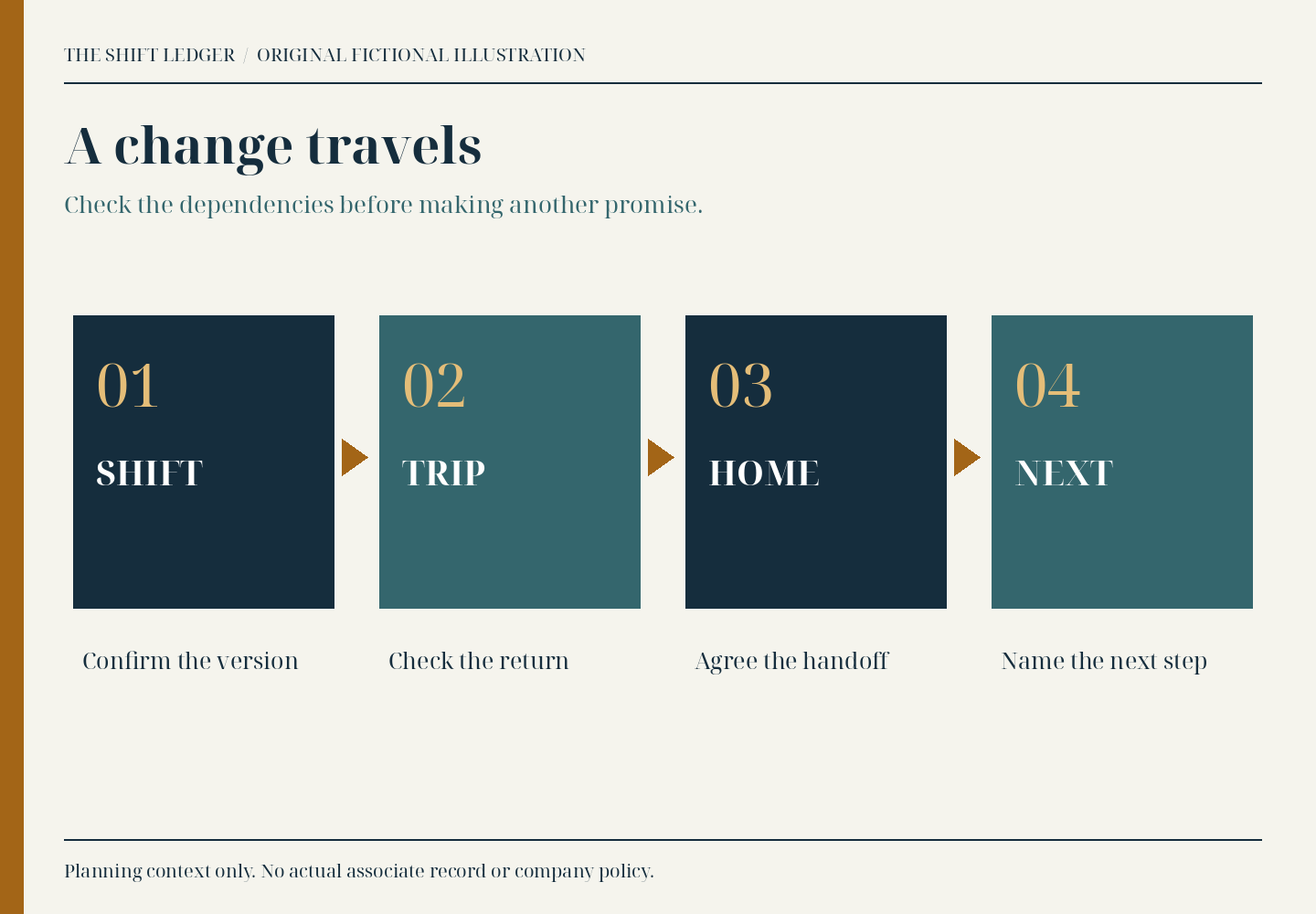
Establish the version before the explanation
Check the date on the schedule and the date of the affected shift. A screenshot, printed copy, calendar reminder, and current authorized system can show different versions. Do not assume that the most convenient copy is the latest, or that a newer timestamp necessarily resolves a contradiction. If two employer-provided sources disagree, describe the conflict to the established contact rather than choosing one based on appearance.
A precise question might be: “For Friday, October 23, my earlier note says noon to six, and the schedule I checked today says two to eight. Which start and finish should I plan around?” The date matters more than a long explanation of your calendar. State when you checked each source if useful. Do not send a whole staff roster just to show your own line; use the employer’s authorized way of discussing the discrepancy.
Recalculate the trip around the new time
Travel is time-specific. A route that works at 6:15 p.m. may not exist at 8:15. Recheck the actual route or ride arrangement for the revised date and finish, including a realistic interval between leaving work and reaching the stop. A map’s typical travel duration is not a promise of a particular departure. Check the transit provider or ride arrangement directly for the details you need.
In the fictional example, the ordinary outbound trip still works, but the return bus would leave before you could reach it. The useful fact is “I have not confirmed a way home after eight,” rather than “the commute is impossible” if you have not explored the actual options. Distinguish verified constraints from alternatives still being considered. That makes a conversation more accurate without minimizing the inconvenience or cost.
Find the first dependent commitment
The first conflict may be outside the shift itself. Someone may be expecting a handoff at 6:45, or a shared vehicle may be needed at 7:00. Locate the earliest commitment that the revised plan can no longer meet. Then decide what needs clarification first. Do not contact every person in your household with a speculative new plan before the work time itself is confirmed.
Once the shift is confirmed, communicate the practical effect to anyone who needs it. Share only the information relevant to their role. “My expected return is now around 8:50; can we discuss the evening handoff?” may be sufficient. There is usually no reason to forward workplace messages, another associate’s name, or an image of an internal schedule. The household needs a workable plan, not an employment record.
State a constraint without inventing a right
You can describe a real difficulty without making an unverified claim about policy or law. “My usual return ride ends earlier, so I need to discuss this finish time” is specific. It does not assert that the schedule must change, and it does not concede that every change is acceptable. If you need an explanation of applicable scheduling requirements or protections, seek an appropriate official or qualified source for your location and circumstances.
Avoid promising a replacement shift or a coworker’s coverage before it has been arranged through the required process. A colleague saying they might be available is not the same as an authorized change. Record the request as pending until you know the outcome. This article does not establish whether swaps are permitted or who can approve them at your workplace; those are questions for current employer instructions.
Confirm the result in a short loop
After a conversation, repeat the practical understanding: the date, start, finish, and any next step. For example, “My understanding is that Friday remains two to eight while the return-time request is being reviewed. Who should I check with about the answer?” Use wording that matches what was actually said. Do not write “approved” merely because someone listened sympathetically or said they would look into it.
If the answer arrives verbally, a brief personal note can record what you understood and when. Follow workplace rules about records and communication; do not secretly record a conversation based on this article. If you are asked to use a particular channel, clarify which information belongs there. The aim is fewer version conflicts, not a second unofficial scheduling system that competes with the employer’s process.
Keep uncertainty visible in your own calendar
A helpful personal calendar can show both the confirmed work block and an unresolved question. Use text such as “return trip to confirm” instead of a color that only you understand. If you share a calendar, consider whether the note exposes more than you intended. A neutral household label such as “evening timing pending” may communicate enough without sharing employment details.
Once the question is answered, remove the obsolete reminder and update dependent plans. Keeping an old alert active can recreate the original confusion days later. Preserve only a concise change history if you need it for a factual question. A list of every speculative alternative is rarely useful after the final arrangement is clear. Separate the record you may need from clutter you no longer need to act on.
Review the pattern without guessing motives
One change may be an isolated disruption. Several changes may reveal that your travel assumptions or availability need another conversation. Look for concrete patterns: later finishes on a certain day, insufficient time between a recurring appointment and a start, or an unreliable return connection. You do not need to infer why a manager scheduled something in order to describe its repeated practical effect.
A useful summary is “Three recent Friday finishes have been later than my return route supports; I would like to discuss my Friday availability.” Bring dates if needed, but keep the opening focused. You are asking about a recurring constraint, not presenting a theory about someone’s intentions. The answer may involve the employer’s current process, a clarification, or a decision you need to make about your own commitments.
End with a usable next action
Before putting the issue aside, identify the next action and its owner. Are you waiting for clarification, checking a transit schedule, or speaking with someone at home? If you are waiting, ask when and through which channel to check again. Do not invent a response deadline on the employer’s behalf. A clear next step prevents a pending request from disappearing inside a busy week.
Public company pages cannot verify your specific shift or a local approval. Use them only for their stated public purpose, and use current employer instructions for your own schedule. Our planning method succeeds when you can state what is confirmed, what remains uncertain, and which dependent plan must change. That is a more dependable outcome than immediately making every square on the calendar look settled.
Sources and scope
Public context checked October 15, 2026. The planning methods and fictional examples are original editorial work. Sources support only their stated public or federal context; they do not verify an individual schedule, pay record or company policy.
- Dollar Tree corporate information — Official public company starting point only; not a private payroll or scheduling procedure.